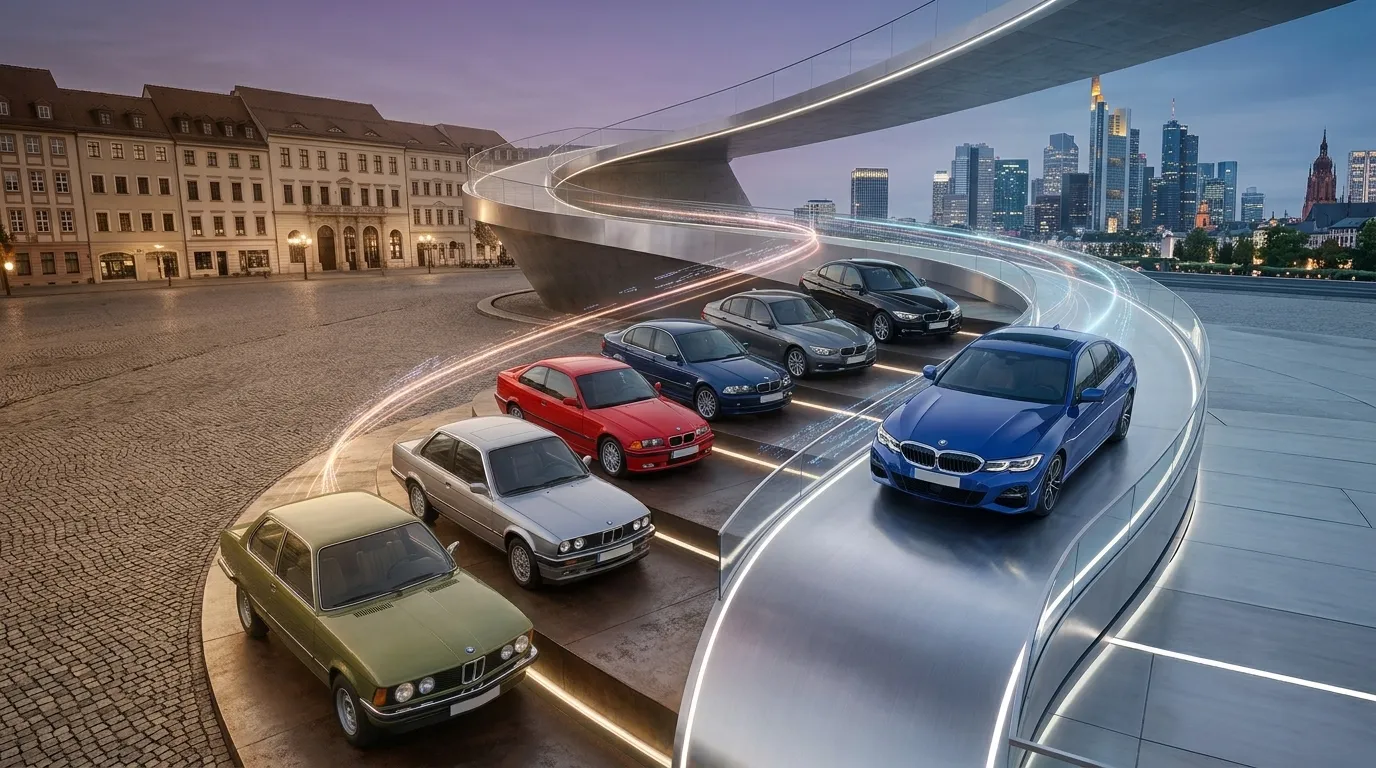
Like any broke car enthusiast in their 20s, I’ve had the dream of one day owning a used entry-level luxury German car. Ever since I owned my first car, I’ve been manifesting this, putting way too much time into researching these things. I’m 27 now, and this dream of owning a German luxury sedan has been five years in the making. Honestly, I don’t know when I’ll actually be able to turn it into reality.
So I thought I’d start putting all my research somewhere in words, instead of letting it all cook up in my head. That way, one day when I do reach the point where I can chase this dream properly, I’ll have these blogs to fall back on as a reference. And if any of you reading this are building toward your own dream car, feel free to use these as a starting point for your research too.
Now, when it comes to the German luxury sedan segment, you mainly have three make options, and each of them offers three models. That leaves you with a set of nine cars to pick from:
- Mercedes with their C-Class, E-Class, and S-Class
- Audi with their A4, A6, and A8
- BMW with their 3 Series, 5 Series, and 7 Series
These are just the most sought-after cars in the used market. All three brands produce a much wider range of options, of course, but for the sake of this series, we’ll stick to these nine.
In this article, we’ll cover the BMW 3 Series, and we’ll pick up the other eight models in separate articles.
Globally, the 3 Series has had seven generations as of 2026, all the way from the first generation that dropped in 1975 to the seventh, which has been on sale since 2018 to this day.
The generations
You’d have heard the BMW geeks saying stuff like E36, F30, and so on. These are chassis codes. The 3 Series has always been sold under BMW’s internal chassis codes (E21, E30, and the rest), and enthusiasts almost always refer to the generations by these codes rather than model years. From the fifth generation onward, each body style got its own code within a generation (sedan, wagon, coupé, convertible), which is why you’ll see a cluster of codes for the newer cars.
BMW only set up its Indian subsidiary in 2007, so everything before that was either an official import through authorised importers like Navnit Motors (who brought in BMWs from 1994, at brutal import duties) or a genuinely private import by someone wealthy enough to not care about the cost. Either way, the pre-2007 cars are rare sightings, not something you’ll casually find in the used market.
First generation: E21 (1975 to 1983)
- The one that started it all, replacing the older 02 Series.
- Body styles: two-door saloon only, plus a Baur convertible conversion. No four-door, no wagon.
- Engines: 1.6 to 2.0 litre M10 four-cylinders to start, with 2.0 to 2.3 litre M20 straight-sixes added from 1977. The six-cylinder cars are recognisable by their quad round headlights.
- Transmissions: four-speed and five-speed manuals, plus a three-speed ZF automatic.
- No M3 in this generation. The hot version was the 323i.
- India availability: never officially sold. BMW had no presence here, and this era predates even the authorised importers. Any E21 in India today would be an extremely rare private import.
Second generation: E30 (1982 to 1994)
- The enthusiast darling, and the one that spawned the legend.
- Body styles: this is where the range expanded a lot. Two-door saloon at launch (1982), four-door saloon added in 1983, convertible in 1985, and the Touring wagon in 1987.
- Engines: M10 and later M40 four-cylinders, M20 straight-sixes, and the 3 Series’ first ever diesel (the M21 six-cylinder). The high-revving S14 four-cylinder powered the M3.
- Transmissions: four-speed and five-speed manuals, plus three-speed and four-speed ZF automatics.
- Two big firsts: the E30 325iX was the first BMW with all-wheel drive, and the first ever M3 was built on this platform.
- India availability: never officially sold. Same story as the E21, any E30 here is a rare private import, though the E30 is desirable enough globally that a few enthusiasts have brought them in over the years.
Third generation: E36 (1990 to 2000)
- Bigger, more grown-up, and more focused on luxury and refinement than the raw E30.
- Body styles: the widest yet. Four-door saloon, two-door coupé, convertible, Touring wagon, and a new three-door Compact hatchback. Five body styles in total.
- Engines: M40, M42, M43, M44 four-cylinders, M50, M52, S50, S52 straight-sixes, plus four and six-cylinder diesels. The M3 used the S50, later enlarged to 3.2 litres.
- Transmissions: five-speed and six-speed manuals (the six-speed arriving in the 1996 M3), plus four-speed and five-speed automatics. This was the first 3 Series to get a five-speed automatic.
- Introduced multi-link rear suspension, a big handling upgrade over the previous cars.
- India availability: not officially sold by BMW, since the subsidiary was still years away. However, this is the era where authorised importers like Navnit Motors were bringing in CBU (completely built-up) cars, so a handful did reach India officially, alongside private imports. Still rare, but slightly less unicorn than the E30.
Fourth generation: E46 (1997 to 2006)
- Widely loved, and for many the definitive “modern classic” 3 Series. Great balance of analogue feel and everyday usability.
- Body styles: four-door saloon, two-door coupé, convertible, Touring wagon, and a three-door Compact hatchback.
- Engines: M43, N42, N46 four-cylinders, M52TU, M54, S54 straight-sixes, plus M47 and M57 diesels. The much-loved E46 M3 used the S54 straight-six.
- Transmissions: five-speed and six-speed manuals, plus five-speed and six-speed automatics. The M3 was also offered with the SMG II automated manual.
- This generation also introduced xDrive all-wheel drive to the saloon and wagon (badged xi and xd).
- India availability: still not officially sold by BMW India (which didn’t exist until 2007), but by now the authorised-importer and private-import routes were more active. The E46’s global production actually overlapped with BMW’s India setup, but it was the E46’s successor that became BMW’s first official India car, not the E46 itself. So any E46 here is an import, not a locally sold car.
Fifth generation: E90 and family (2005 to 2013) — the India debut
- Chassis codes: E90 (saloon), E91 (Touring wagon), E92 (coupé), E93 (convertible). This is where each body style got its own code.
- Body styles: saloon, wagon, coupé, and convertible.
- Engines globally: N43/N45/N46 four-cylinders, N52/N53 naturally aspirated sixes, N54/N55 turbo sixes, plus M47/N47 and M57/N57 diesels. The E90-era M3 was special: it used the S65 4.0 litre V8, the only V8 ever fitted to an M3.
- Transmissions: six-speed manual and a six-speed ZF automatic across most of the range, with a seven-speed dual-clutch (DCT) on the M3. The automatic is what most India cars came with.
- This is the big one for India. The E90 was BMW’s first official India car, assembled locally at the new Chennai plant from 2007 via the CKD (completely knocked-down) route. It also debuted the iDrive system here, and it won World Car of the Year in 2006.
- India availability: officially sold, finally. Note the timing gap though. The E90 launched globally in 2004 to 2005, but Indian assembly and sales only started in 2007, so the practical starting point for a locally sold used 3 Series is 2007 onward. Diesel (the 320d) dominated Indian sales through this era, with the 320i, 325i, and 330i petrols also offered. The straight-six 325i and 330i are the enthusiast picks.
Sixth generation: F30 and family (2011 to 2019)
- Chassis codes: F30 (saloon), F31 (Touring wagon), F34 (3 Series Gran Turismo, the taller five-door fastback). The coupé and convertible split off into the separate 4 Series from this point, so they’re no longer part of the 3 Series.
- Body styles in India: the F30 saloon was the mainstay, with the F34 Gran Turismo also sold here.
- Engines: this is where BMW went fully turbocharged across the range. N20 and later B48 four-cylinder petrols, N47 and later B47 diesels, and the B58 straight-six in the range-topping 340i.
- Transmissions: six-speed manual or the excellent eight-speed ZF automatic (the 8HP). Nearly every India car is the eight-speed auto, and it’s widely regarded as one of the best torque-converter automatics ever made.
- India lineup: launched here in 2012 with the 320d and 328i, both 2.0 litre turbos. The lineup evolved over the years, with the 328i’s petrol later replaced by the 330i (the B48 engine), and the 320d remaining the volume seller. A facelift (LCI) arrived around 2016 with the new modular B-series engines.
- India availability: officially sold. This generation is arguably the current sweet spot for a used entry-luxury German in India, old enough to have depreciated hard, new enough to feel modern.
Seventh generation: G20 and family (2018 to present)
- Chassis codes: G20 (standard-wheelbase saloon), G21 (Touring wagon), G28 (long-wheelbase saloon).
- Body styles in India: the standard G20 saloon, and later the long-wheelbase version.
- Engines: B48 2.0 litre four-cylinder petrols (320i, 330i), B47 2.0 litre diesels (320d), and the B58 straight-six in the M340i.
- Transmissions: the eight-speed ZF automatic across the India range. A six-speed manual existed in some markets until 2022, but India only ever got the eight-speed auto.
- India lineup: the G20 arrived here in 2019. In 2021, BMW launched the 330Li, the long-wheelbase 3 Series, its first ever long-wheelbase model for India, aimed at chauffeur-driven buyers and replacing the outgoing 3 GT. The M340i xDrive, the quick straight-six version, began deliveries in early 2023.
- India availability: officially sold, and still the current car. Too new to be a used-market bargain yet, but worth knowing as the endpoint of the lineage.
The ones worth chasing
E21 to E46
These are rare finds in India, especially the E21 and the E30. I personally don’t remember ever seeing an E21 or an E30 on Indian roads, though I have had friends of friends who owned an E30 in Kerala.
Now, even if you do manage to find a rare E30, E36, or E46 in India, they’ll be listed for a shit ton of money, which defeats the whole purpose of our entry-to-luxury concept.
And when I say a shit ton of money, I mean it literally. Here are some listings I found online for an E30, an E36, and an E46 (all of them sold now, dug up from some old Instagram listings):
- E30, listed February 2025, for 25 lakh
- E36, listed November 2024, for 45 lakh
- E46, listed September 2024, for 20 lakh
I believe the E30 is a genuinely good pick if you’re someone in a European or American market. Speeed swears by it as the best project car you can pick up, since the E30 chassis is solidly built and has near-unlimited mod potential. And apparently it’s dirt cheap in the western markets. I’ve seen people pick up a working-condition E30 for under 2000 dollars in YouTube videos, which, to put it in perspective, is less than what you’d pay for an Alto 800 in the Indian used market.
The E46 is the one I’d chase if I had the money to burn for it. This is my most nostalgic 3 Series, or better yet, my most nostalgic BMW full stop, because my introduction to BMW was through a version of the E46: the M3 GTR, in Need for Speed Most Wanted. The M3 GTR is a very rare
I was also fortunate enough to visit the BMW museum in Munich, where I saw this car in person. I’ll drop a few 3 Series pictures I took there, including the M3 GTR on display.
E90 family
Most 90s and early 2000s kids who grew up watching Malayalam movies know this generation of BMW, from that iconic M3 E93 convertible in Mammootty’s entry scene in the 2010 film Pokkiriraja.
Since this was the first mass-produced (CKD) and mass-sold India model, it’s estimated to have sold anywhere from 11,000 to 12,000 units over its Indian lifetime from 2007 to 2012. Because of that, this is the cheapest 3 Series you’ll find in the Indian market. Through all the years I’ve been drooling over the 3 Series, I’ve seen listings on Facebook Marketplace and OLX going from 3 lakh and up, though at that 3 lakh end, the condition is going to be questionable.
The E90 is praised for its “soul” as a driver’s car, thanks to its hydraulic steering. But I’d steer clear of this one too, because it’s plagued by maintenance gambles and aging components that can be costly to sort out. This generation also had its share of recurring complaints: cooling system failures, oil leaks, and interior degradation, just to name a few.
F30 family
This generation of the 3 Series is considered the sweet spot when it comes to buying a pre-owned BMW. It’s said to have solved a lot of the recurring complaints of the previous generations, and it grew noticeably in size, enough that you could confuse it with earlier 5 Series models. That size bump also gave it better interior space and rear-seat comfort compared to the E90’s cramped cabin.
With all those advantages though, some say it lost its soul, because the hydraulic steering was replaced with electric power steering and a lighter suspension. I’ve heard that the lighter suspension was actually an India-specific spec, and I’ve seen people swap it out as soon as they pick up an F30, so that’s worth keeping in mind.
I’ve seen good-looking F30s with Kerala plates listed from as low as 8 lakh, but I’d suggest going for a later model with decent mileage on the odometer, a good service history, and hopefully single ownership, or as low an ownership count as you can find. I believe it’s easier to pick a good car for a slightly higher price than to pick a cheap one and pour money into fixing issues after buying. That said, you’ll still have to be ready for the occasional breakdown and repair, because this is a German car, and moreover a BMW.
As for the engine, I’d go for the 320d. It’s really efficient, it’s one of the most sold options in India, and owners report it’s surprisingly refined and reliable for a diesel. Plus, until the proposed isobutanol mix is introduced in diesel 🤞, you don’t have to worry about your prized gem getting ruined by the E20 ganne ka juice.
We don’t have multiple transmission options here, since India only ever got the goated 8-speed ZF automatic. It’s one of the most loved automatic gearboxes across any car and any generation, so no complaints there. I do wish we’d gotten the manual as well, though. With the automatic, you can almost use this as a daily driver, a family car, an all-in-all car, even your only car, if you take care of it properly. Speaking of taking care of it, the F30 was the first 3 Series where BMW’s iDrive came as standard, and it can show you details like how many more kilometers you have until each separate fluid change, along with other maintenance windows like brake pads and other wear-and-tear items.
G20 family
This might be a controversial opinion, but unlike a lot of people I’ve talked to about this, I prefer the looks of the G20 over the F30. That said, I wouldn’t recommend the G20 for your entry used BMW purchase. For one, since it’s the current generation and still in production and on sale, it’ll be a little more expensive than the F30 or the E90 families. And people in the automotive industry pretty unanimously say the G20 is less reliable than the F30, that it reintroduced a lot of the issues the F30 had once solved. Being the modern generation, it also comes packed with a lot of tech and complex electronics, and that complexity comes with a cost. It seems to have more persistent wear items too, which cost significantly more to replace than on the previous generations. Knowing all this, if you have the money, I’d say go for it, but it wouldn’t be my pick for an entry used BMW.
As for the price, you can pick up an early-model G20 in good condition from around 20 lakh onwards. Being comparatively new, the chances of finding a good car with a solid service history and a low ownership count are much higher in this generation.
The G20 is also nearing the end of its lifetime. We can expect the eighth generation, internally codenamed G50, to enter production globally around late 2026, reaching India likely by 2027 or so. With the newer generation arriving, the G20’s value could dip a bit. But I wouldn’t wait around for it to fall into the 10 to 15 lakh range of the F30 any time soon.
If you’ve read this far, you’re probably chasing the same dream I am. My honest take: the F30 is the one to hold out for. But whichever way you go, do the boring homework, check the service history, walk away from the suspiciously cheap ones, and buy the best-kept car you can stretch to. Future you, sitting in the driver’s seat, will thank you for the patience.
What Is a Homologation Special?
Vehicle homologation is the mandatory legal and technical certification process confirming a vehicle model meets specific safety, design, and emission standards required to be roadworthy and sold in a country.
A homologation special is a road car built mainly to satisfy those rules, usually because a racing series requires a minimum number of road-legal cars to be sold before the racing version is allowed to compete.
